


FLAG OF ALL COUNTRIES
FLAG OF ALL COUNTRIES

-
Samples: LA CO NAURU GIA RE TAI HCM
- Manufacturing: INOX TINTA VIETNAM CORPORATION
- Commitment to quality: 24 Month Warranty
- Quantity Ordered Products: 10000
- Inox Product Price Quote Not VAT
Inox product details
Nauru cheap flag in HCM. The official name is the Republic of Nauru, which is an island nation in Micronesia in the South Pacific.
Nauru cheap flag in HCM . Nauru (English pronunciation: / nɑːˈuːruː / (heard)), officially called the Republic of Nauru, is an island nation in Micronesia in the South Pacific. With 9,378 residents living on an area of 21 square kilometers (8.1 sq mi), Nauru is the smallest country in the South Pacific, the third smallest in the world in terms of area, after the Vatican City and the Principality of Monaco. , and is the smallest island nation in the world. In addition, Nauru is the republic with the smallest area in the world. Nauru flag.
After the Micronesians and Polynesians settled in Nauru, the island was annexed and declared a colony by the end of the nineteenth century. After World War I, Nauru became a trustee territory of the League of Nations administered by Australia, New Zealand, and the United Kingdom. During World War II, Nauru was occupied by the Japanese army. After the war, the island became a trust territory again. Nauru gained independence in 1968. The cheap Nauru flag in HCM.
Nauru is a phosphate rock island, rich in resources near the surface, so it is easy to conduct open-cast mining. The island has some phosphate reserves, but it is no longer economical to exploit. In the late 1960s and early 1970s, Nauru had the highest per capita income among sovereign nations. When phosphate reserves are depleted, and the environment is severely compromised by mining operations, a fund is set up to manage the island's slowly declining assets. In order to earn income, Nauru quickly became a tax haven and illegal money laundering center. From 2001 to 2008, Nauru allowed Australia to set up a Nauru detention center in exchange for aid.
President Nauru is also the head of a 19-member unicameral parliament. Nauru is a member of the United Nations, the Commonwealth, the Asian Development Bank and the Pacific Islands Forum. Nauru also participates in the Commonwealth Games and the Olympics.
Micronesians and Polynesians were the first people to live in Nauru, at least 3,000 years ago. Traditionally, there are 12 clans or tribes in Nauru, represented by a 12-pointed star on the flag. According to tradition, Nauru people traced their origins based on matriarchy. The islanders are engaged in aquaculture: they catch small ibija fish, adapt them to freshwater environments, and raise them in Buada lagoon, they provide the island residents with a stable source of food. . In their meal ingredients there are other locally grown things like coconut and pineapple. The name "Nauru" may be derived from Anáoero, in Nauru, which means "I go to the beach". In 1798, British captain John Fearn, a whale hunter, became the first Westerner to visit Nauru, He named the island "Pleasant". From around 1830, the Nauru had contact with the Europeans by the whaling boats and merchants supplementing their reserves (especially fresh water) in Nauru. Around this time, defectors from European ships began to live on the island. Islanders traded food for coconut wine and firearms. The firearms used in the Nauru Tribal War began in 1878 and lasted 10 years.

Nauru was annexed by Germany in 1888 and incorporated into the German Protectorate of the Marshall Islands. The arrival of the Germans ended the civil war on the island, and the kings were made ruler of the island. The most widely known of them is Vuong Auweyida. Christian missionaries from the Gilbert Islands to Nauru in 1888. The settled Germans called the island Nawodo or Onawero. The Germans ruled Nauru for nearly three decades. Robert Rasch was a German businessman married to a Nauru woman, he was the island's first administrator, appointed in 1890.
In 1900, explorer Albert Fuller Ellis discovered phosphate at Nauru. Pacific Phosphate Company began to exploit the resource in 1906 under an agreement with Germany, exporting its first phosphate shipment in 1907. In 1914, after the outbreak of World War I, Australian troops captured Nauru. Australia, New Zealand and the United Kingdom signed the Nauru Island Agreement in 1919, setting up a committee called the British Phosphate Commission, which took over phosphate mining rights.
Nauru experienced an influenza pandemic in 1920, with an mortality rate of 18 percent among indigenous Nauru people. In 1923, the League gave Australia trustee authority over Nauru, with the United Kingdom and New Zealand as co-management. On 6 and 7 December 1940, the auxiliary cruisers Komet and Orion of Germany sank five supply ships in the vicinity of Nauru. Komet then fired artillery at phosphate mining areas, oil depots, and cargo beams onto the island.
The US Air Force bombed Japan's landing zone at Nauru
The Japanese army occupied Nauru on August 25, 1942. The Japanese built an airport, which was first bombed by the Allies on May 25. 3 years 1943 to prevent food supply is transported by air to Nauru. The Japanese deported 1,200 Nauru people to the Chuuk Islands as laborers. Nauru was ignored by the US military and left in their Pacific operations, and finally liberated on 13 September 1945, when the commanding officer Hisayaki Soeda surrendered to the army. Australia. Arrangements were made to repatriate 737 surviving Nauru from Chuuk. They returned to Nauru in January 1946. In 1947, the United Nations established a trust regime in Nauru, with Australia, New Zealand, and the United Kingdom acting as trustees.
Nauru was autonomous in January 1966, and became an independent nation in 1968 under President Hammer DeRoburt.
In 1967, the Nauru people acquired the property of the British Phosphate Commission, and in June 1970 control was transferred to the locally owned Nauru Phosphate Company. Mining income helps the Nauru to become one of the highest living standards in the Pacific. In 1989, Nauru took legal action against Australia in the International Court of Justice for Australia's management of the island, namely Australia's failure to overcome the environmental damage caused by its operation. mining cause. Certain Phosphate Lands: Nauru v. Australia led to an out-of-court settlement to revamp the fully exploited areas of Nauru. Nauru cheap flag in HCM.
Processing of stainless steel - Similar products


Products
inox - Featured Products







STAINLESS STEEL HOT NEWS

A Historic Parade: 50 Years of Southern Liberation with TinTa Flagpoles
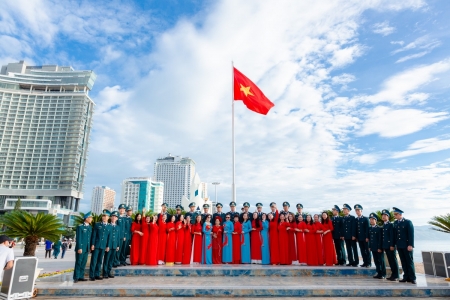
What is a 360-degree rotating stainless steel flagpoles

We would like to introduce to readers about stainless steel flagpoles

Install an office flagpole in a diplomatic meeting

Flagpole office good meeting place it is so important
tinta's Customer support
Mr Hoang Thai (Vietnam/English)
Ms Thùy Dung (Vietnam / English)
Hoàng Gia Phú (Mr)
Mr Viết Sáu (Vietnam/English)